
Latest Announcement

Lansdowne Conservancy Awarded $19,300 Grant
The Loudoun Invasive Plant Species Management Program (IPSMP) awarded a $19,300 grant on June 24, 2026, to Lansdowne Conservancy. The funding will support a multi-year effort to treat and remove invasive plant species and restore the area with native plants.
Invasive plant species are non-native plants that reproduce rapidly and cause harm to the environment, the economy, or human health. They outcompete native plants for light, water, and soil nutrients, leaving native insects, birds, and animals without food or shelter. Many invasive plants were originally introduced for landscaping or erosion control before their aggressive nature was realized.
The focus is on the pond near the old stone pumphouse on Woodridge Parkway. The few native plants currently growing in the pond buffer are threatened by the density and aggressiveness of invasive species. Stilt grass, lespedeza, Multiflora rose, and Bradford pear are the predominant invasive species.
Nature Works Professional Land Management will treat the invasive species and restore the pond buffer to improve water quality, prevent erosion, and encourage desired wildlife. Nature Works estimates that the initial treatment of invasive plants will begin in late July. Follow-up treatments are expected in September, with planting of natives in October. The site will be monitored for invasives for a three-year period.
The IPSMP was launched with support from the Loudoun Invasive Removal Alliance (LIRA). Lansdowne Conservancy has been a proud member since 2025. The alliance now includes 88 communities, representing more than 230,000 Loudoun residents. The program’s broader goal is to raise awareness of the economic, environmental, and health impacts of invasive plants -ultimately encouraging residents and retailers alike to stop buying, selling, and planting these harmful species.
Watch for project updates and volunteer opportunities within the Conservancy. An invasive removal event is being planned for Earth Day 2027. No experience necessary. It would be wonderful to see you there.
For additional information:
https://www.loudoun.gov/InvasivePlants (Invasive Plant Species Management Program)
https://www.loudouninvasives.com (Loudoun Invasive Removal Alliance / LIRA)

Before Treatment
After Treatment
After Treatment
After Treatment
After Treatment
After Treatment
Woodridge Pond Update Fall 2026
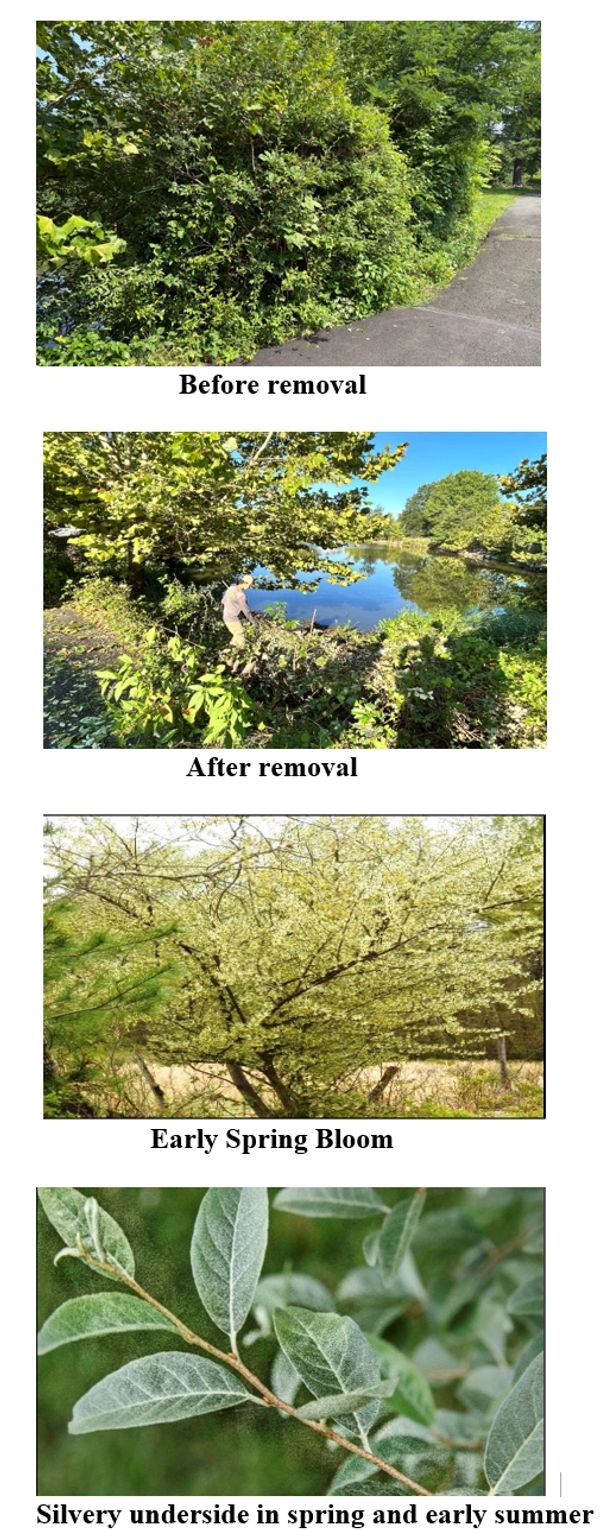
Nature Works Professional Land Management has returned to the pond on Woodridge Parkway
to continue treating and removing invasive plant species. The work is part of the Invasive Plant
Species Management Plan (IPSMP), which is funded by a $19,300 grant from Loudoun County
to the Lansdowne Conservancy. The plan was launched with support from the Loudoun Invasive
Removal Alliance (LIRA).
Non-native invasive plants displace native species, disrupt food chains, and reduce biodiversity.
This effort aims to curb their spread.
Target species: Autumn Olive (Elaeagnus umbellata)
Autumn Olive is an aggressive, persistent shrub that can grow to 15 feet tall and wide. It was
introduced to the U.S. in the 1830s and widely planted for land reclamation in the 20th century,
including on strip mines.
Early Spring Bloom Silvery underside in spring and early summer
Wildlife does eat its fruit, but the sugary berries are essentially junk food, especially for
migrating birds, which need high-fat, high-protein diets to fuel their flights.
Autumn Olive thrives in poor, disturbed soils. It can form dense stands along roadsides and
spread into open forests, crowding out native plants. It also increases soil nitrogen levels, which
can wash into streams and rivers as nitrate pollution.
Once Autumn Olive takes hold, it persists for years, which is why continued treatment matters.
Stay tuned for the spring treatment update. In the meantime, enjoy the pond and watch it change
with the seasons.
For additional information:
https://www.loudoun.gov/InvasivePlants (Invasive Plant Species Management Program)
https://www.loudouninvasives.com (Loudoun Invasive Removal Alliance / LIRA)